App Marketing in 2026: A Field Guide From Live Accounts
Most app marketing plans are really ad plans with a launch date attached. This is the wider view we use with founders: what to do before launch, what changes after it, and how the whole business grows without living or dying by its cost per install.
Key takeaways
- App marketing is the whole system that turns strangers into retained, paying users, not just the paid acquisition line in the budget.
- Each stage has a different job: pre-launch proves demand, launch earns ranking and reviews, growth scales what already retains.
- Positioning decides your store page, your creative and your onboarding, so settle it before you spend serious money on ads.
- Channels beyond paid, such as web-to-app, referral, partnerships and community, lower your blended cost and make paid scale easier.
- Run the business from a small metrics stack: Day-30 retention, cost per retained user, payback period and blended LTV to CAC.
01What app marketing really covers in 2026
When founders ask us for help with app marketing, the first conversation is usually about ads. How much should we spend on Meta, should we try TikTok, what is a good cost per install. Those are fair questions, but they sit at the end of a much longer chain. App marketing is everything that decides whether a stranger hears about your app, installs it, gets value in the first session and is still there a month later paying for it.
That chain has more links than most plans admit. Positioning shapes the store page. The store page shapes conversion rate. Conversion rate shapes what you pay per install. Onboarding shapes Day-1 retention, and Day-1 retention shapes whether any of the money you spent comes back. If one link is weak, the whole plan looks like an advertising problem when it is really a product or messaging problem wearing an advertising costume.
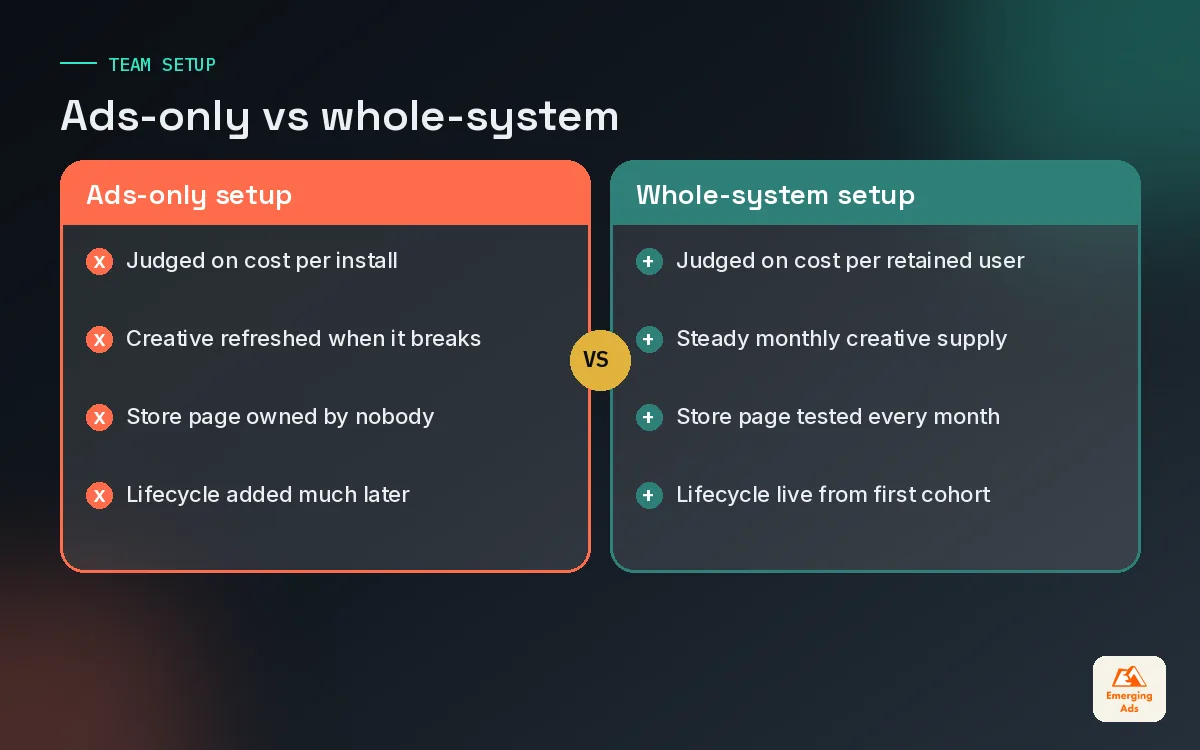
On accounts we manage, the apps that grow steadily share one habit: they treat acquisition, store presence, onboarding and lifecycle messaging as one system with one owner. The ones that stall usually have an ads person, a product person and a CRM person each optimising their own number in isolation. Our app marketing service exists largely to close those gaps.
App marketing vs app user acquisition
User acquisition is one department inside app marketing. It is the paid and organic engine that brings new installs, and we wrote a whole piece on building an app user acquisition system for teams that need that level of detail. This guide steps further back. It covers the decisions you make before acquisition is even worth funding, and the channels that do not show up in an ad account at all.
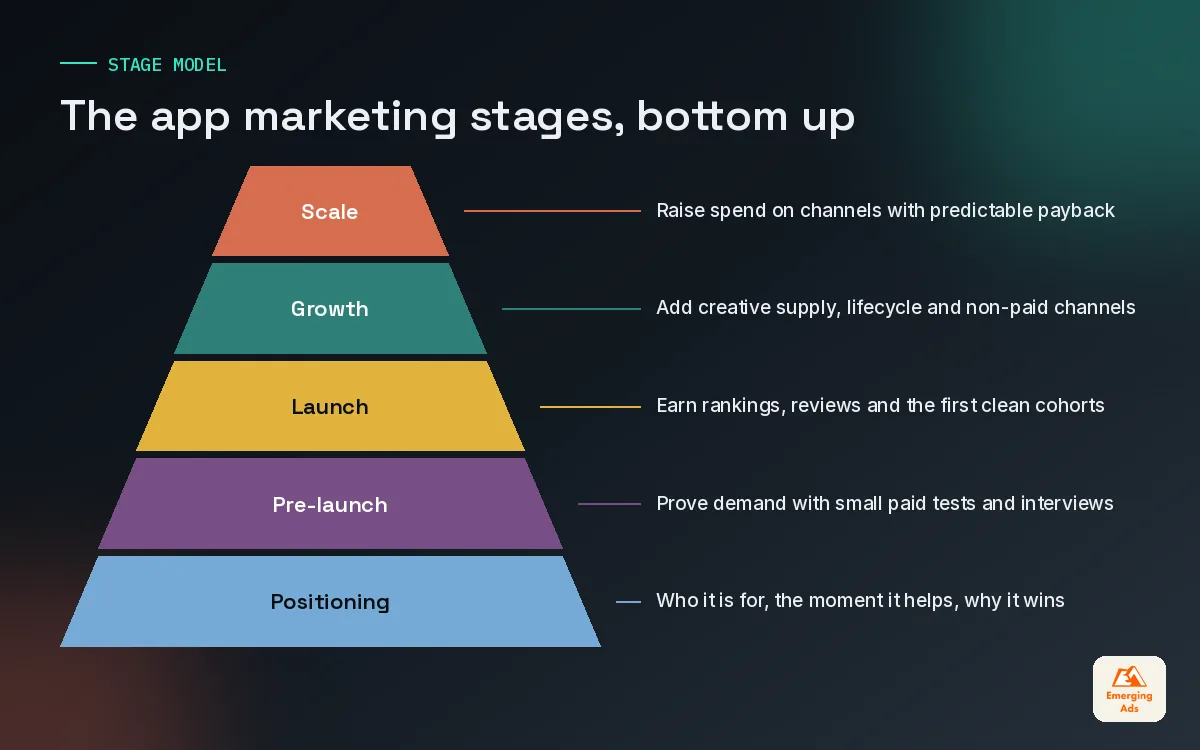
02The three stages of app marketing and what each one is for
Every app business moves through roughly three stages, and the most expensive mistake we see is running a stage-three plan at stage one. Scaling spend before you have proof of retention simply buys you a larger pile of users who leave.
Stage one: pre-launch
The job here is to prove demand and sharpen the message, not to collect vanity sign-ups. A landing page with two or three positioning angles, a waitlist, a small paid test to see which angle earns the cheapest qualified sign-up, and a handful of user interviews tell you more than a polished launch video. If you are building the waitlist page, keep it as fast and focused as any good landing page design project: one promise, one action, proof where you have it.
Stage two: launch
Launch is about earning early momentum in the stores: installs concentrated over a short window, a steady flow of honest reviews and a store page that converts. This is also when you discover what real users do in the first session, which is nearly always different from what the team expected. Expect to change onboarding at least twice in the first six weeks.
Stage three: growth
Growth starts when a cohort retains well enough that you can predict its value. Only then does scaling paid acquisition make sense, because you finally know what a user is worth and how long it takes to earn back what you paid for them. Growth is also where channels beyond paid start to matter most, because they pull your blended cost down while paid does the heavy lifting.
| Stage | Main job | Signal you are ready to move on | Common trap |
|---|---|---|---|
| Pre-launch | Prove demand, pick a position | One angle clearly wins on cost per qualified sign-up | Building a waitlist nobody activates |
| Launch | Earn rankings, reviews and first cohorts | Day-7 retention stable across three or more weekly cohorts | Buying installs to chase a chart position |
| Growth | Scale what already retains | Payback period predictable within a few weeks | Raising budget faster than creative supply |
03Positioning: the app marketing decision that sets everything else
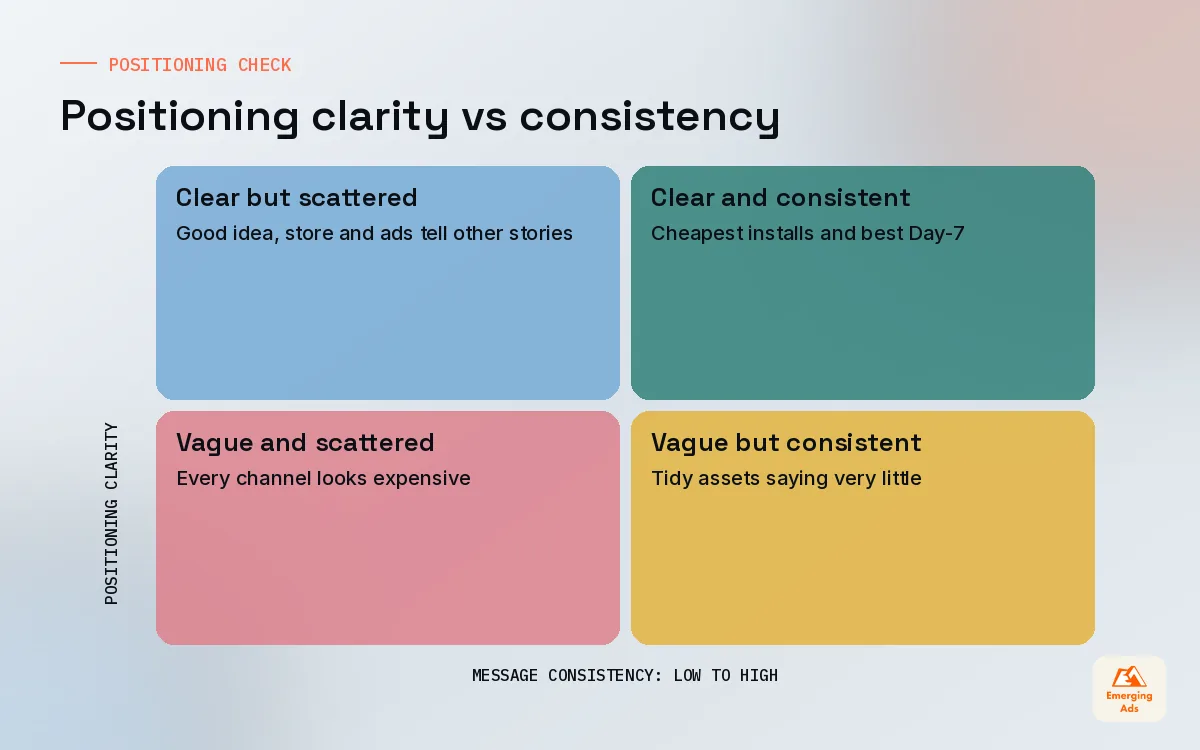
Positioning sounds like a branding exercise, but for apps it is very practical. Your positioning becomes the first two screenshots on your store page, the first three seconds of your ads and the first screen of your onboarding. If those three places tell different stories, users notice the mismatch and leave.
We write app positioning as one sentence with three parts: who it is for, the specific moment it helps with, and why it is better than what they do today. A budgeting app “for people who freeze when they open their banking app” is a very different product to market than one “for households who want to plan a year ahead”, even if the features overlap heavily.
Where positioning shows up first
- The store page. Your app name and subtitle on the App Store each allow up to 30 characters, so there is no space for a vague promise. The positioning has to survive being that short.
- Screenshots. The first two carry most of the weight. We treat them as a billboard for the one moment the app helps with, not a tour of every feature. Our app store optimisation work starts here more often than with keywords.
- Ad hooks. A clear position gives creative teams a fixed idea to test variations of, which makes testing faster and cheaper.
- Onboarding. The first session should deliver the exact moment the ad promised. If the ad sells calm budgeting and onboarding opens with a twelve-field form, retention suffers.
If you want the store side in more depth, our practical guide to app store optimisation covers metadata, creative assets and testing in detail.
04Channels beyond paid that make paid cheaper
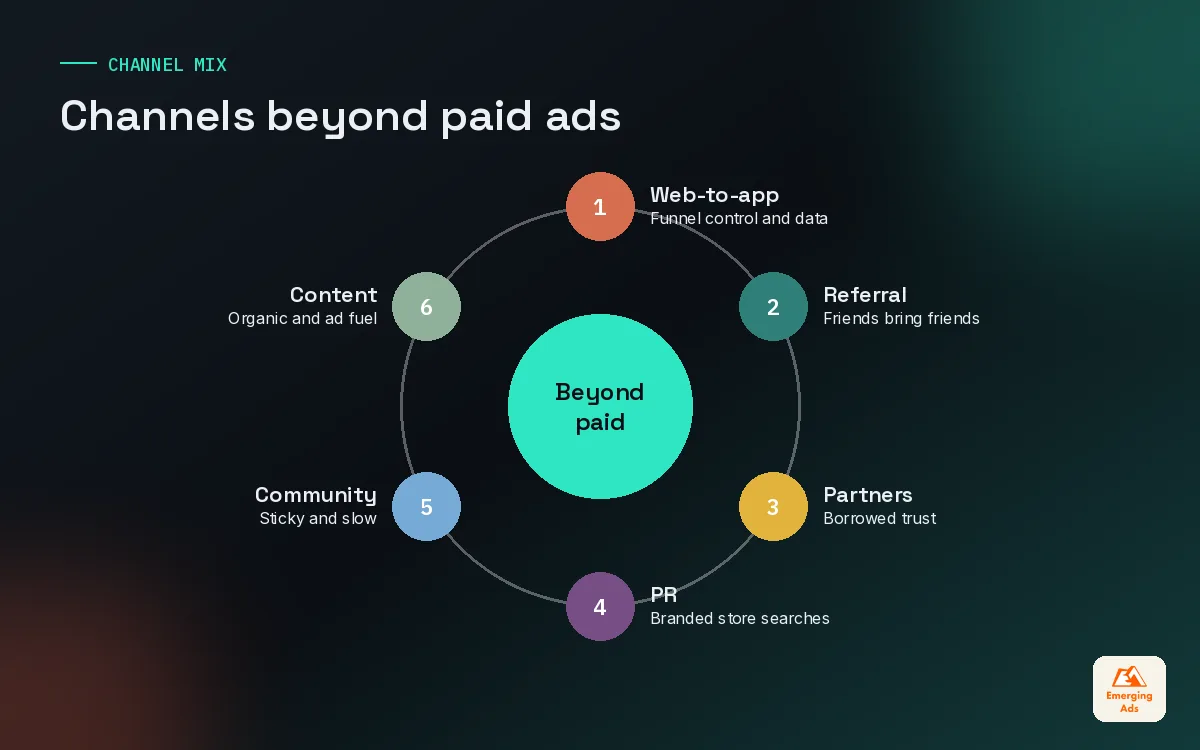
Paid acquisition is the most controllable growth channel, which is exactly why teams lean on it too heavily. The healthiest app marketing plans we run have two or three non-paid channels quietly contributing a meaningful share of new users. Each one lowers the blended cost per retained user and gives the paid team more room to bid.
Web-to-app
Many apps, especially subscription apps, now send some paid traffic to a web page first, take the sign-up or even the payment on the web, and then hand the user into the app. It gives you more control over the funnel, a richer view of who converted and, for some business models, better margins. It also needs careful tracking and a well-built page, so it is a project rather than a toggle.
Referral
Referral works when the app is better with a friend, or when users already talk about the outcome. A fitness app with shared challenges or a marketplace where both sides earn something can grow meaningfully through referral. A note-taking app usually cannot, and forcing a referral prompt into it mostly annoys people.
Partnerships and PR
Partnerships put your app in front of an audience that already trusts someone else: a bank recommending a savings app, a gym chain bundling a training app, a creator building a programme on your platform. PR still matters for launches and funding moments, mainly because it drives branded searches in the stores, which tend to convert far better than generic ones.
Community and content
Community is slow but sticky. A busy subreddit, Discord or creator circle around your category keeps users engaged between sessions and feeds the creative team with real language. Short, honest video content also does double duty: it builds an organic presence and becomes raw material for ads. A small, consistent video content production rhythm is often worth more than one expensive shoot.
| Channel | Best suited to | Time to see results | What it needs from you |
|---|---|---|---|
| Web-to-app | Subscription and fintech apps | Weeks | A strong web funnel and clean tracking |
| Referral | Social, marketplace and fitness apps | Months | A reward that makes sense for both sides |
| Partnerships | Fintech, health and edtech apps | Months | A partner whose audience already trusts them |
| PR | Launches and funding news | Days to weeks | A story that is genuinely new |
| Community | Games and hobby apps | Months to a year | Someone who owns it every week |
Timeframes in this table reflect what we typically see on accounts we manage and will vary by category.
05Budgeting your app marketing plan by stage
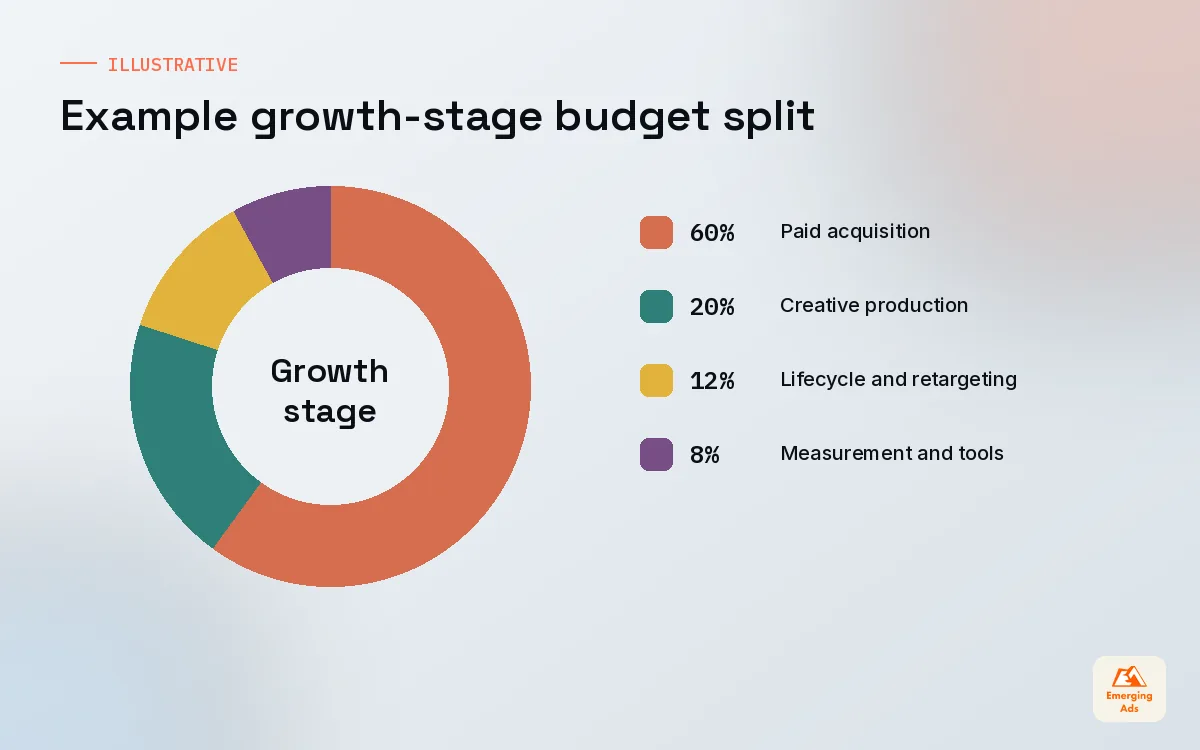
There is no correct percentage of revenue to spend on app marketing. What matters is that the budget matches the stage and that each pound has a job you can measure. Here is how we usually split a plan, with the caveat that every category behaves differently.
- Pre-launch: most of the money goes on small, sharp tests of positioning and on the store page and landing page assets. Paid spend is a research budget, not a growth budget.
- Launch: a concentrated burst of paid installs across two channels at most, plus creative production, plus a tracking setup you trust. This is not the time to test five networks.
- Growth: paid acquisition takes the largest share, but creative production and lifecycle messaging should grow with it. If budget rises and creative output stays flat, fatigue will cap your scale within weeks.
Lifecycle work is the line that gets cut first and should be cut last. Re-engaging users you already paid for is nearly always cheaper than buying new ones, which is why we pair acquisition with app retargeting and lifecycle email flows as soon as a cohort is big enough to segment.
The cheapest install you will ever buy is the user who already installed, drifted away and only needs one good reason to come back.
06Team and agency setup for app marketing
Small app teams rarely need a large marketing department. They need clear ownership of five jobs, and an honest view of which ones they can do in-house.
- Growth lead. Owns the plan, the budget and the metrics stack. Often the founder at first.
- Acquisition. Runs paid channels day to day, reads cohort data and briefs creative.
- Creative. Produces a steady supply of new concepts, not just resizes of the same idea.
- Store and onboarding. Owns the store page, ratings, onboarding tests and conversion rate.
- Lifecycle. Owns push, in-app messages and email after install.
The split we see working most often is a founder or growth lead in-house who owns the numbers and the product decisions, with an agency running acquisition, creative supply and measurement. The founder keeps the product context, and the agency brings pattern recognition from many accounts. What fails is handing over the whole of app marketing and expecting product changes to happen by themselves.
Questions to ask any app agency
- Do you report on cost per retained user and payback, or only on installs and cost per install?
- How many new creative concepts do you expect to ship each month at our budget?
- Who sets up and audits the measurement before spend starts?
- Can you show cohort results from apps in a similar category on your client success stories?
07The app marketing metrics stack we run every week
App dashboards tend to grow until nobody reads them. We keep the weekly view to a short list and push everything else into deeper reports for when something moves.
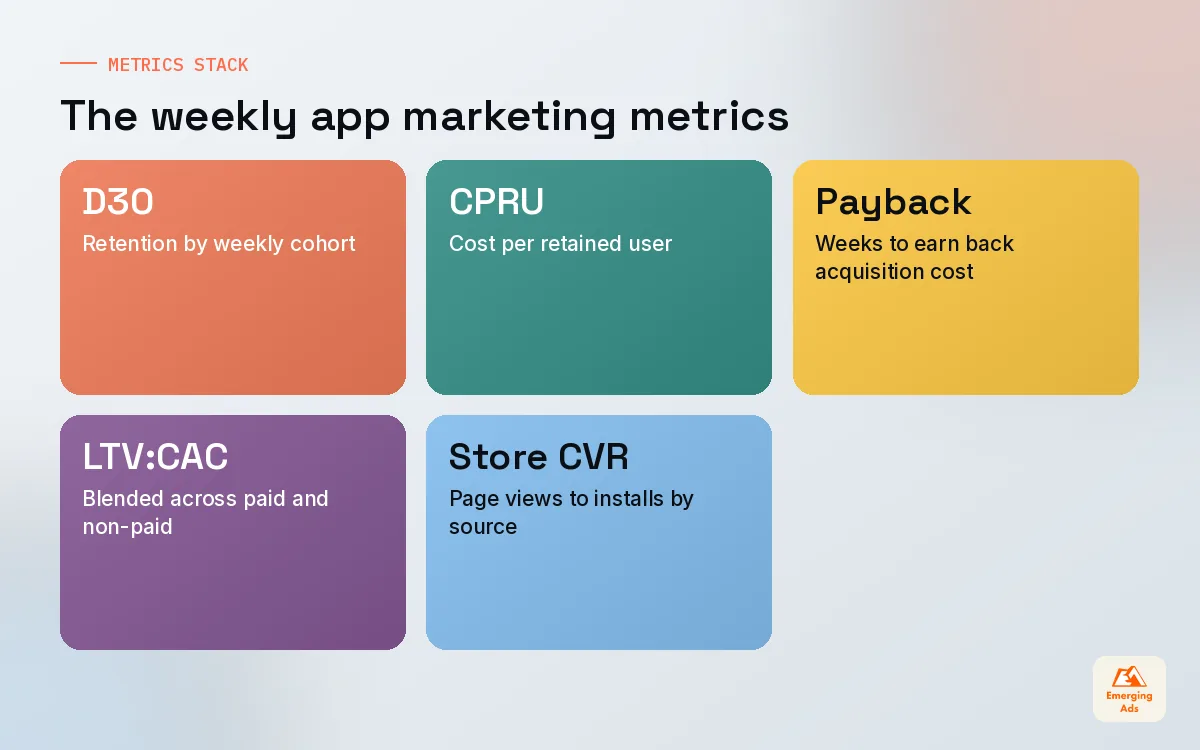
The weekly five
- Day-30 retention by cohort. The clearest single signal of product and audience fit. We also watch Day-1 and Day-7 as early warnings.
- Cost per retained user. Spend divided by users still active at Day-7 or Day-30. It corrects for channels that buy cheap installs that vanish.
- Payback period. How long a cohort takes to earn back what you paid to acquire it.
- Blended LTV to CAC. Lifetime value against cost across all channels, paid and non-paid together.
- Store conversion rate. Page views to installs, split by traffic source where the stores allow it.
Getting these numbers right depends on measurement. On iOS, Apple’s App Tracking Transparency, which arrived with iOS 14.5 in April 2021, means apps must ask permission before tracking users across other companies’ apps and sites, so a share of your data arrives through privacy-preserving frameworks such as SKAdNetwork rather than user-level attribution. A mobile measurement partner such as AppsFlyer, Adjust, Branch or Singular sits in the middle, and a product analytics tool such as Mixpanel, Amplitude or Firebase shows what users do once inside. We help teams set up Mixpanel product analytics alongside their MMP so the two views agree, and we use proper attribution modelling when the blended picture matters more than any single channel report.
Retention deserves its own deep dive, and our app retention guide walks through cohorts, onboarding and lifecycle in far more detail than we can fit here.
08A 90-day app marketing plan for a growing app
To make this concrete, here is the shape of a first quarter we might run for a subscription app that has launched, has a few thousand monthly active users and wants to grow without losing control of payback. The figures are illustrative and depend heavily on category.
| Weeks | Focus | Key output | Decision at the end |
|---|---|---|---|
| 1 to 2 | Audit measurement, cohorts and store page | Trusted baseline for the weekly five | Which link in the chain is weakest |
| 3 to 6 | Fix the weakest link, start two paid channels | First clean cohorts with known cost per retained user | Which channel earns a bigger budget |
| 7 to 10 | Creative cadence, store tests, lifecycle flows | Higher store conversion and Day-7 retention | Whether payback supports scaling |
| 11 to 13 | Scale the winning channel, open one non-paid channel | Lower blended cost per retained user | Next quarter’s budget and hiring |
Notice how much of the first month is spent on things that are not ads. That is deliberate. Teams that skip the audit usually spend the second month undoing decisions made on bad data.
09Bringing it together
Good app marketing is less glamorous than the conference talks suggest. It is a clear position, a store page that converts, onboarding that delivers the promise, a paid engine that buys retained users rather than installs, and two or three quieter channels that make the whole thing cheaper. Most of the wins we see come from fixing the weakest link in that chain, not from finding a secret new network.
If you want help putting the pieces together, the youremergingads.com homepage has more of our app growth thinking, and you can browse the full range of EmergingAds services to see how acquisition, creative and measurement fit together under one team. When paid acquisition is ready to scale, our app install campaigns team picks it up with the same focus on Day-30 users and payback.
Frequently asked questions
Straight answers to what clients ask us most about app marketing.
What is app marketing?
How do you market an app before launch?
How much should I spend on app marketing?
What is the best channel for app marketing?
What is web-to-app marketing?
Which metrics matter most in app marketing?
How long does it take for app marketing to work?
Should I hire an agency or build an in-house app marketing team?
How does ATT affect app marketing?
Do I need app store optimisation if I run paid ads?
What is a good app marketing strategy for a subscription app?
Want a second pair of eyes on your app growth plan?
We will look at your stage, your numbers and your channel mix, then tell you plainly where the next pound of budget should go and where it should not.
Book your free audit